/
Mar 31, 2026
Why We Built an Autonomous Sales AI, and What It Means for B2B Teams in Europe
Most AI sales tools solve the wrong problem. They automate the output without rethinking the workflow. We spent six months building one that does both. This is the story behind Blake.
/
AUTHOR

Lucas Kuijper
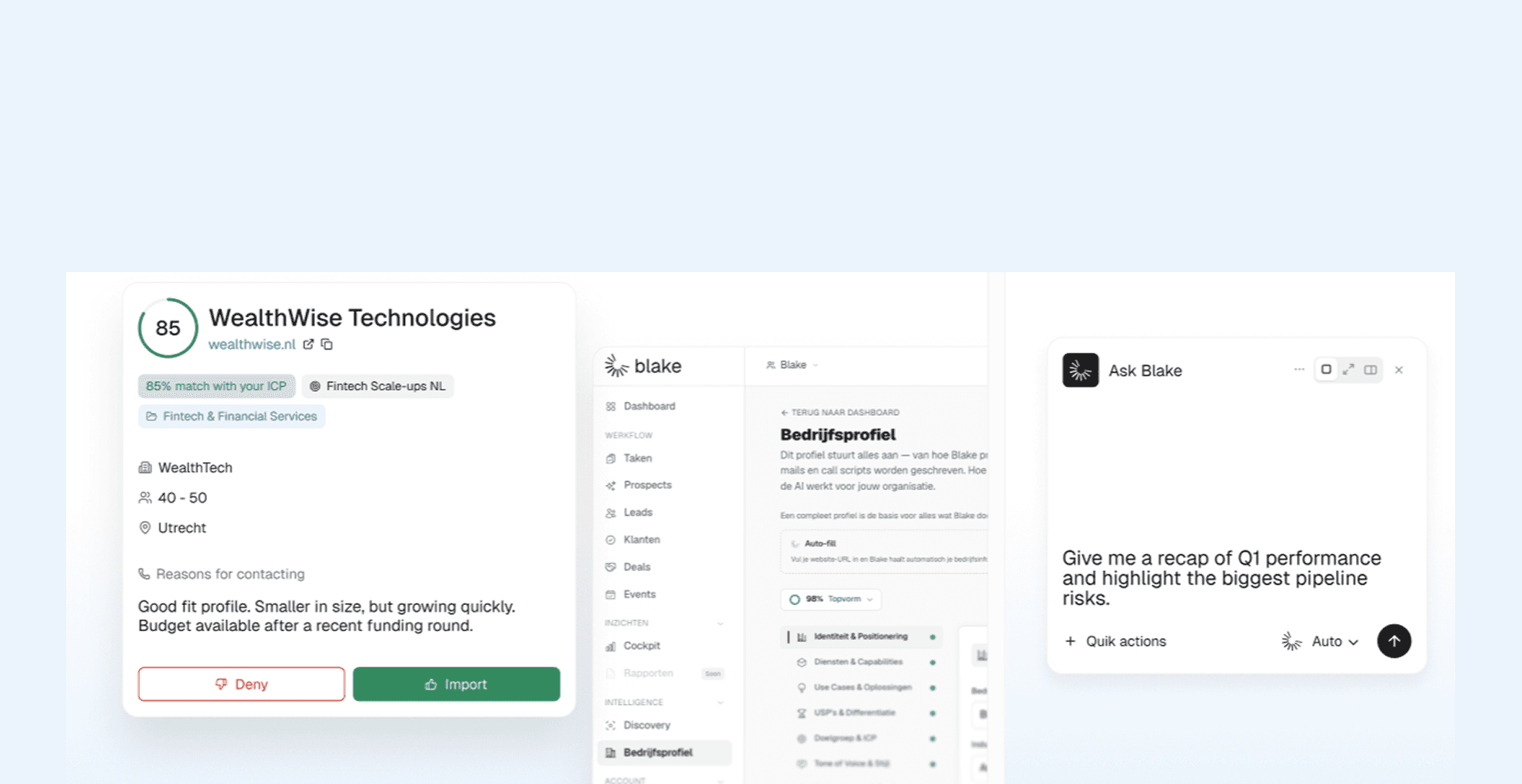
There are over 11,000 sales tools on the market due to AI and fragmented tooling. The category has never been more crowded. Yet the way most B2B sales teams operate in 2026 looks remarkably similar to how they operated in 2019: manual prospecting, disconnected CRMs, templated outreach, and pipeline forecasts built on gut feeling rather than activity data.
CRM platforms were designed as record-keeping systems. They capture what happened. They do not surface what should happen next. They do not find new prospects. They do not qualify leads against a learning profile. They do not write contextual outreach. And they certainly do not improve autonomously based on your win/loss patterns.
The recent wave of "AI-powered" CRM features has not meaningfully changed this. Adding a language model to a database does not make it intelligent. It makes it faster at producing the same low-signal output that sales teams already struggle with.
We know this firsthand, because we are experts in building such systems. Compared to the market giving us a more specialist view to separate the wheat from the chaff.
From internal frustration to product thesis
Subduxion builds applied AI systems for enterprise organizations across Europe. Our work spans computer vision, NLP, data architecture, and agentic automation. We operate from the AI Center on High Tech Campus Eindhoven, alongside companies like Philips, ASML, and NXP.
We understand how to build software and AI that works in production. At scale. Under compliance constraints.
But when it came to our own commercial process, we faced the same structural problem every growing B2B company faces. Six tools open simultaneously. Four browser tabs competing for attention. No single view of pipeline health. More time spent administrating the sales process than executing it.
The inflection point was not a market analysis. It was operational pain. The kind that compounds quietly until you realize you are spending your evenings updating CRM records instead of preparing for the conversations that actually close revenue.
That is when we decided to build internally what we could not find externally.
What Blake is, and what it is not
Blake is not a CRM. It is not a plugin. It is not a layer on top of existing software that adds marginal convenience.
Blake is an AI-native sales platform: a system designed from the ground up to handle prospecting, qualification, outreach, and pipeline management as a unified, learning workflow.
The distinction matters. Most sales tools treat these as separate modules that users must manually connect. Blake treats them as stages in a single feedback loop where each interaction informs the next. It replicates the perfect sales development representative (SDR).
Core capabilities in production today
In our pre-launch (as of May 2026) we are currently able to do the following in Blake:
Autonomous discovery. Blake continuously scans the market and surfaces companies that match a workspace's ideal customer profile. Each prospect is enriched with firmographic data, scored on fit, and prioritized. No manual research required.
Self-learning ICP. Rather than requiring teams to manually define and maintain their ideal customer profile, Blake learns from every deal outcome and system interaction. The profile sharpens autonomously. After sufficient training data, the system understands a team's market positioning better than any static filter could.
Contextual AI outreach. Personalized emails and call scripts generated from the full context of a prospect's profile, interaction history, and optimal timing. Not template-based. Not generic. Contextual.
Conversational interface. Teams interact with Blake in natural language. "Who should I prioritize today?" "Draft a follow-up for the Acme deal." "Why is pipeline velocity declining this month?" Blake responds with actions, not dashboards.
Pipeline intelligence. Revenue forecasting based on real activity data, not self-reported stages. Deal risk alerts when opportunities stagnate. Coaching signals that surface which team members need support and which are outperforming.
Early signals from private beta
We are cautious with projections. The data from our private beta, however, paints a consistent picture:
60% reduction in time spent on manual prospecting
2x faster path from new lead to first meaningful action
45% improvement in follow-up speed on qualified opportunities
The most telling metric is retention. Teams that adopt Blake do not revert. Once a sales workflow is structured around autonomous prospecting and learning-based qualification, returning to manual processes feels like returning to paper maps after GPS.
Why this is a European problem that requires a European solution
The global sales technology market is dominated by tools built for the American sales model: high-volume cold outreach, spray-and-pray sequences, and conversion funnels optimized for scale over substance.
European B2B sales operates differently. Longer cycles. More stakeholders. Relationship-driven decision-making. Regulatory frameworks, GDPR, the EU AI Act, that are not afterthoughts but structural requirements.
Blake is architectured for this reality:
EU-hosted infrastructure. All data processing on European servers.
GDPR compliant by design. Not retrofitted. Built with data sovereignty as a foundational constraint.
EU AI Act ready. Explainability, human oversight, and audit trails built into the system architecture.
Enterprise-grade security. Multi-tenant isolation, role-based access control, MFA, and audit logging from day one.
Europe does not need a localized version of an American sales tool. It needs a system that understands how business is conducted here, under the governance frameworks that define our operating environment.
What comes next
Blake opens for general availability in April 2026. Not as a beta. As a product.
The near-term roadmap includes:
Multi-channel outreach sequences. Orchestrated cadences across email, LinkedIn, WhatsApp, and phone, managed autonomously by Blake.
Bi-directional CRM synchronization. Bring your existing CRM. Salesforce, HubSpot, Pipedrive, Odoo. Blake integrates with your stack rather than replacing it.
Website visitor signals. Identify which companies visit your site before they fill out a form.
Anonymous regression on workspace data. Blake trains on the specific patterns of each workspace. The longer a team uses it, the better it becomes.
Embeddable lead capture. Forms that connect directly to Blake's pipeline, deployable on any website.
We are building at a pace most early-stage companies cannot sustain. Our advantage is structural: we already have the AI engineering team. We do not need to recruit ML expertise. We are the ML team.
The thesis behind Blake
The strongest software products do not emerge from market research. They emerge when practitioners are frustrated enough with the status quo to build what they actually need. Slack started as an internal tool at a games studio. Figma was born from frustration with Adobe. Notion exists because its founders could not organize their own workflows.
Blake exists because we could not sell effectively with the tools available to us. And every founder, sales leader, and SDR we show it to recognizes the exact same problem.
We are funding Blake entirely from Subduxion's existing operations. No external capital dictating product direction. No quarterly board pressure compromising product quality. Founder-level standards. Zero compromises.
Is that the fastest path to growth? No. Is it the path that produces something that still exists in ten years? We believe so.
For teams that recognize this problem
Blake is built for founders running their own pipeline without drowning in tools. For sales leaders who need visibility into what their team actually does. For SDRs ready to stop spending eight hours a day on manual prospecting.
We are onboarding select companies now. Not everyone. We are choosing teams where Blake creates the most impact and where we learn the most.
April is approaching. If this resonates, this is the time to get involved.
Explore Blake at useblake.ai